
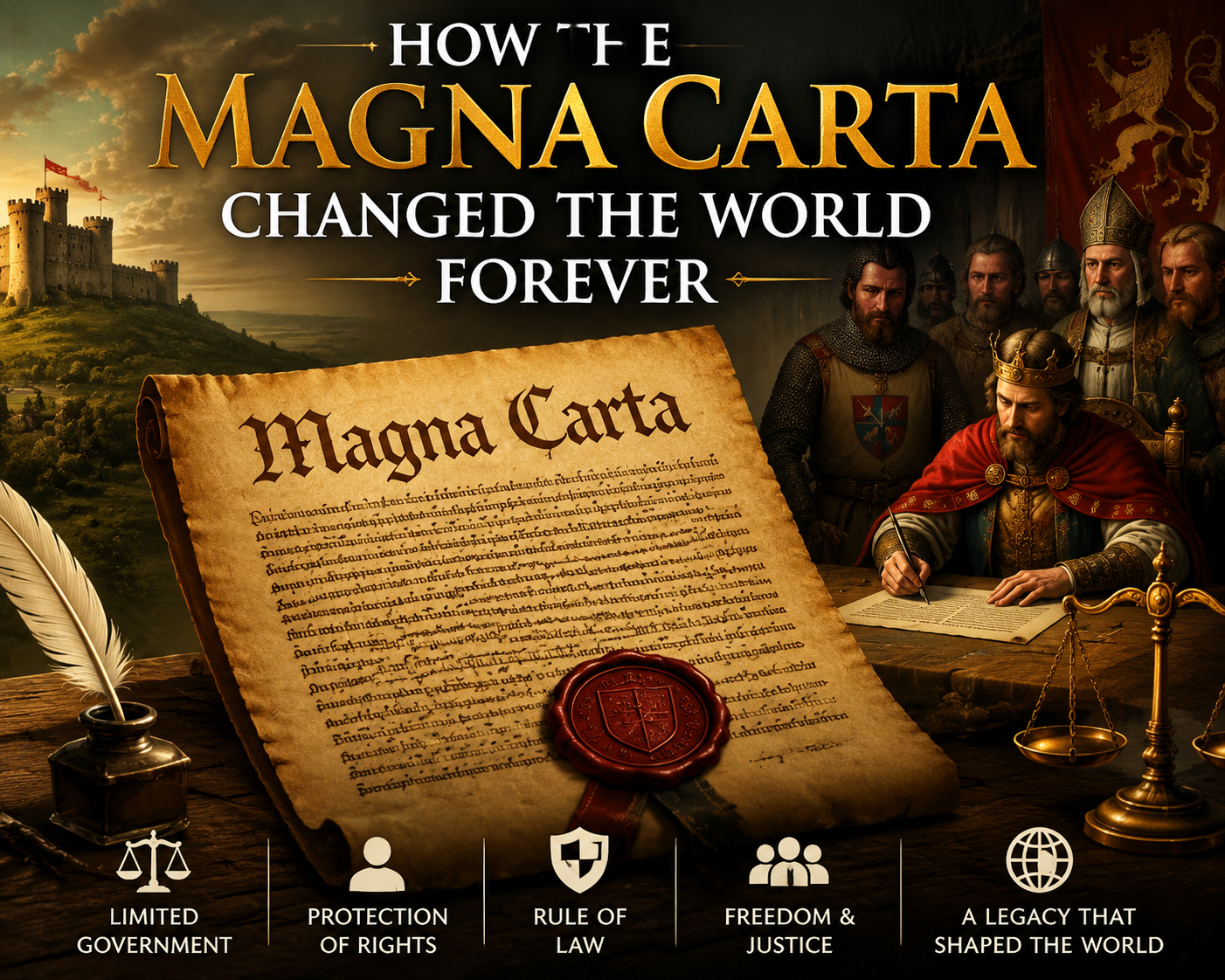

A Meadow, a Seal, and Eight Centuries of Consequence
On a June morning in 1215, in a damp riverside meadow at Runnymede beside the Thames, a despised English king was surrounded by his own rebellious barons and compelled to press his royal seal into wax on a document he had every intention of ignoring as soon as the immediate crisis had passed. King John got his wish, briefly — the Pope annulled the charter within weeks, England descended into civil war, and John himself was dead within eighteen months. Yet the document he sealed that morning has outlasted virtually every king, empire, and political system that has arisen and fallen in the eight centuries since. It is not an exaggeration to say that most of the world’s people today live under legal and political systems shaped, in some traceable way, by the principles first committed to parchment in that meadow. The Magna Carta did not merely reform English law. It changed the architecture of human civilisation.
What It Actually Said
The charter’s sixty-three clauses, read plainly, addressed the immediate grievances of feudal barons chafing under an oppressive and incompetent king. Many of its specific provisions — fixing the exact amount a baron’s heir must pay to inherit an estate, regulating the obligations of fish weirs in the Thames — are of purely antiquarian interest today. But buried among these feudal technicalities were two clauses of staggering long-term consequence.
Clause 39 stated: No free man shall be seized, imprisoned, dispossessed, outlawed, exiled, or ruined in any way, nor in any way proceeded against, except by the lawful judgment of his peers and the law of the land.
Clause 40 stated: To no one will we sell, to no one will we deny or delay, right or justice.
These two sentences contained, in compressed and unassuming form, the entire philosophical seed of constitutional democracy. A ruler could not simply imprison a person by personal whim. A court could not simply be bought. Justice was a right, not a favour dispensed at the Crown’s pleasure. In 1215, these principles applied narrowly — only to free men of property, a small fraction of England’s total population. But the principle, once written and sealed and entered into law, proved impossible to confine within those original, narrow boundaries. It expanded, generation by generation, century by century, continent by continent, until it now governs the treatment of every person arrested in a courtroom from Washington to Wellington.
England and the Common Law Tradition
The Magna Carta’s immediate legacy was the slow, uneven growth of English common law — a legal system built not from a single comprehensive code handed down by a central authority, but from case by case accumulation of precedents reasoned in open court, recorded, and available for the next judge to weigh. Over three centuries, the charter was reissued and reaffirmed more than forty times, weaving itself so thoroughly into English legal identity that by the time Edward Coke confronted King James I in 1607 with the declaration that the king himself stood “under God and the law,” he was not inventing a new principle. He was insisting England had always held one.
From Magna Carta’s clauses grew the writ of habeas corpus, formalised in the Habeas Corpus Act of 1679, which demanded that any person detained by the state be produced in open court and the lawfulness of their detention tested before a judge. From it grew the presumption of innocence, the right to a fair trial, the independence of judges from political interference, and the principle of equality before the law regardless of wealth or rank. These doctrines, developed over centuries in English courts, became the foundational grammar of justice across the entire English-speaking world.
Carried Across the Atlantic
When English colonists landed in North America, they brought the common law tradition with them as naturally as they brought their language and their Bible. The Massachusetts Bay Colony’s 1641 Body of Liberties cited Magna Carta explicitly. The Mayflower Compact of 1620 rested on the same conviction that a people could covenant together under law for their mutual governance. The phrase “no taxation without representation,” the rallying cry of the American Revolution, was a direct Magna Carta argument: the charter’s own insistence, built upon in subsequent centuries, that the Crown could not levy taxes without the consent of those being taxed.
When Thomas Jefferson drafted the Declaration of Independence in 1776, he drew directly on John Locke, who had spent two volumes arguing that the constitutional principles Magna Carta established were grounded in natural law prior to any king’s authority. When the Constitution of the United States was framed in 1787, its Fifth Amendment — No person shall be deprived of life, liberty, or property without due process of law — was a direct restatement of Magna Carta’s clause 39, almost word for word, transplanted from a thirteenth-century English meadow into the founding document of the world’s most powerful republic. The Sixth Amendment’s guarantee of a speedy and public trial by jury is Magna Carta’s guarantee that justice shall not be delayed, extended to every citizen regardless of class. The entire Bill of Rights, in its architecture and instinct, is Magna Carta grown large and made democratic.
The Westminster Model and Its Global Family
As Britain’s empire expanded, it carried its legal and political inheritance with it, and the nations that have since emerged from that inheritance form one of the largest families of common legal culture in human history. Canada, Australia, New Zealand, India, South Africa, Ghana, Nigeria, Jamaica, Bangladesh, Malaysia, Singapore — each of these nations, upon independence, retained and built upon the common law system, the presumption of innocence, the independent judiciary, and the parliamentary framework that traced their lineage directly back through British constitutional history to the charter sealed at Runnymede.
India presents the most striking case. The world’s largest democracy, governing more than 1.4 billion people across extraordinary religious, linguistic, and cultural diversity, operates under a constitution explicitly modelled on Westminster parliamentary principles and a legal system rooted in English common law. Indian courts routinely cite British precedents; the presumption of innocence, habeas corpus, and the right to be heard before an independent judge are constitutional guarantees in India as in England, not because India chose to copy Britain uncritically, but because these protections proved, on honest examination, to be worth keeping regardless of who first devised them.
Singapore, a city-state with no natural resources, built its celebrated stability and prosperity substantially on the foundation of a rigorous, independent, common-law court system inherited from British administration. International businesses choose Singapore as a base for dispute resolution specifically because of the predictability, transparency, and independence its courts offer — all qualities traceable directly to the same rule-of-law tradition that runs back through Magna Carta. The common law, in Singapore’s case, became a competitive economic advantage worth billions of dollars annually.
The Gulf States: Sharia and Common Law, Side by Side
Perhaps the most striking evidence of Magna Carta’s global reach lies in places one would least expect to find it: the oil-rich Gulf states, whose legal systems are grounded in Islamic Sharia and whose rulers have no formal historical connection to British constitutional tradition whatsoever.
Yet examine the commercial and civil legal codes of the United Arab Emirates, Qatar, Bahrain, Kuwait, and Saudi Arabia, and a remarkable pattern emerges. Each of these states operates a dual legal system. Sharia courts govern personal status matters — marriage, divorce, inheritance, and religious observance — according to Islamic jurisprudence. But their commercial courts, their contract law, their arbitration frameworks, and much of their civil liability law is built, often almost directly, on models drawn from English common law, because any nation seeking to participate meaningfully in the modern global economy has discovered that it needs a legal infrastructure through which international businesses can reliably form contracts, enforce agreements, and resolve disputes — and the international standard for exactly that infrastructure is the common law tradition that grew from Magna Carta.
The Dubai International Financial Centre, established in 2004, operates its own independent court system explicitly based on English common law, using English as its working language, and citing English and other common law precedents alongside its own rulings. The DIFC Courts are regarded internationally as among the most sophisticated commercial dispute resolution institutions in the entire Middle East region, and they rest their entire authority and credibility on a legal tradition whose roots lie in thirteenth-century England. Qatar’s financial centre operates on a nearly identical model. Abu Dhabi Global Market, established in 2013, adopted English common law as the foundation of its civil and commercial legal framework explicitly and by deliberate government choice — not because anyone compelled Abu Dhabi to do so, but because the market demanded the predictability, transparency, and rule-of-law dependability that eight centuries of common law tradition had built.
Even Saudi Arabia, whose official legal system is the most comprehensively Sharia-based of any Gulf state, conducts its international commercial arbitration and investment agreements through frameworks that operate according to internationally recognised common law principles, and Saudi businesses engaging in cross-border transactions rely routinely on English law as the governing law of their contracts. This is not coercion or cultural imperialism; it is the free-market recognition that the legal system most capable of sustaining complex international commercial trust is the one whose principles were first sketched in the meadow at Runnymede.
The Human Rights Revolution
No account of Magna Carta’s global impact would be complete without tracing its line to the great human rights documents of the twentieth century. When Eleanor Roosevelt chaired the drafting committee that produced the Universal Declaration of Human Rights in 1948, the document it produced — the nearest thing the modern world has to a universal statement of the principles that should govern the treatment of every human being on earth — rested almost its entire structure on exactly the principles Magna Carta had first expressed: that every person possesses dignity and rights that no government may simply override, that no one may be arbitrarily detained, that all are equal before the law, that justice must be accessible and fair.
The European Convention on Human Rights, signed in 1950, gave those principles legally enforceable teeth across Europe. The International Covenant on Civil and Political Rights, adopted by the United Nations in 1966 and now ratified by more than 170 nations, extends them globally. Every single one of these documents is, in traceable and documented intellectual lineage, the great-grandchild of those two clauses sealed at Runnymede on a June morning in 1215.
Why One Meadow Changed Everything
Historians have long debated exactly how much credit Magna Carta deserves as an independent cause, as opposed to a convenient symbol for principles that were already developing across Western Europe by the thirteenth century. The debate is legitimate, and this article does not wish to overstate the case. But what England uniquely possessed, that most of continental Europe did not, was an island geography that protected its legal development from the repeated, disruptive foreign conquest that so often forced other nations to rebuild their legal systems from scratch; a common law tradition that developed incrementally through open courts rather than through periodic wholesale imposition of new codes; and, from the sixteenth century onward, a printed English Bible placing the conviction that even kings answer to a law higher than their own will into the hands and hearts of every ordinary reader across the kingdom.
Magna Carta was the seed. The English Bible, the common law’s centuries of accumulated reasoning, the Parliament that grew around them, and the navy and commerce that carried all of it to five continents — these were the soil, water, and sunlight that turned that seed into the tree whose branches now shade more of the world’s legal and political life than any other single institution in human history.
Eight hundred years after a reluctant king pressed his seal into wax beside the Thames, the document he sealed governs, directly or indirectly, the rights and protections of more human beings than have ever been covered by any other single legal instrument. Not because Britain was perfect. Not because empire was always benevolent. But because the principles that seed contained — that power must answer to law, that justice must not be sold or delayed, that every person has the right to be heard before an independent judge — proved, wherever they took root, to be true. And truth, once let loose, is extraordinarily difficult to stop.
End of article.